
Foshan Furniture
In Longjiang, finished furniture has its own trade fair, while fabrics, panels and hardware have another. In Lecong, sofas, tables, chairs and cabinetry are arranged into complete living and dining rooms. Nearby Jiujiang, in Nanhai, has developed manufacturing in upholstered furniture and office seating, among other categories.
What makes Foshan distinctive is the way its workshops, component suppliers and showrooms are spread across these towns. Follow a sofa, a dining set or a wall of cabinets and you can see both how furniture is made here and how many forms one category can take.


1. Shunde’s Furniture Industry: Manufacturing in Longjiang, Showrooms in Lecong
Furniture Design and Manufacturing in Longjiang
Longjiang’s International Dragon Furniture Fair runs alongside the Asia International Furniture Materials Expo. One show presents sofas, tables, chairs and complete furniture sets. The other brings the materials and components behind those pieces into view. In the workshop shown here, workers shape wooden parts, with rows of chair frames visible nearby. The workshop shows how arms, backs and legs take shape. The fair shows how those same parts look once they are assembled, finished and upholstered. Shunde’s supply network also reaches Lunjiao, where the local woodworking machinery association lists equipment for solid wood and panel processing, spray finishing and material handling.

Local Suppliers of Panels, Fabrics, Foam and Hardware
A Longjiang district feature on seating describes a local supply network for panels, upholstery fabrics, foam and hardware. A fabric book photographed in Lecong shows how textile suppliers present their own products through samples with different weaves and shades. Cabinetry has a similar supply network. In Leliu, DTC makes hinges, drawer runners, drawer systems and lift mechanisms. A finished piece might be on display in one part of Shunde, while nearby markets and factories show its fabric, runners or doors as products in their own right.

Furniture Markets and Brand Showrooms in Lecong
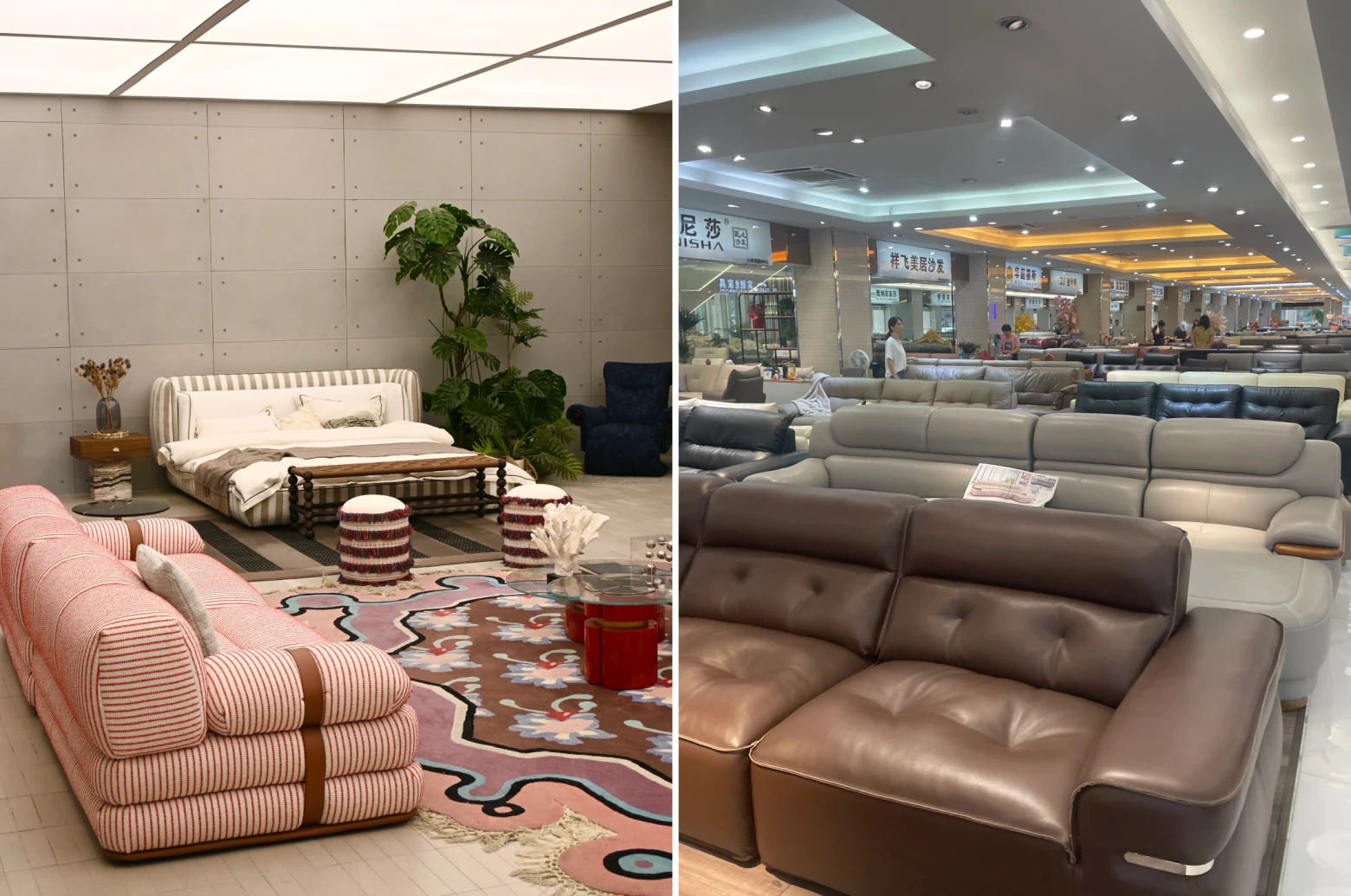
The China National Furniture Association identifies Lecong as a furniture trading cluster. The Louvre and Sunlink complexes are both part of that showroom corridor. The Louvre’s glass atrium connects several floors, with furniture displayed in individual brand showrooms. Some shops stage complete living and dining rooms. Others, like the showrooms photographed at Sunlink South, line up sofas or coffee tables so that many versions of a single category can be seen together. A showroom address identifies where a piece was displayed. Its place of manufacture depends on the individual product.

2. Sofas and Lounge Chairs: Straight, Corner and Modular Designs
Straight Sofas: Backs, Arms and Seat Cushions
Sofas connect two parts of Foshan’s furniture industry. A documentary from Longjiang traces the town’s industry through sofas and chairs, and Foshan’s municipal news outlet lists upholstered furniture among Jiujiang’s manufacturing sectors. In the Lecong showroom shown here, a pale straight sofa has a divided back and seat framed by wide arms. The frame, padding and upholstery all contribute to that outline. A straight sofa in a similar fabric can look quite different when the back runs uninterrupted and the seat uses a single bench cushion.

Corner Sofas and Chaise Layouts
In a Sunlink South showroom, a corner sofa runs along the wall. Two rows of seats meet at the corner, the cushions continue around the turn, and a coffee table sits in the space between them. A chaise sofa can have a similar L-shaped outline, but the extended section is at the end of a single row and provides room to stretch out. The difference lies in whether two rows meet at a corner or one end seat extends forward.

Modular Sofas: Seats, Corners and Ottomans
Showroom photographs from Lecong and Longjiang show a sofa with separate bases and back cushions. The divisions remain visible along the seat and down to the base. Within a modular range, end seats, armless seats, corners and ottomans can be arranged in several ways. Some units connect with plates or clips underneath. The photos show where the upholstered units meet. The connectors themselves sit out of view.

Wood-Framed, Fully Upholstered and Swivel Chairs
A rocking chair photographed during a visit to Lecong and Longjiang leaves its wooden arms, side frames and curved runners visible. The yellow cushions sit inside that structure. The same visit also turned up fully upholstered seating, where fabric can wrap continuously from the back around the sides. Some swivel chairs tuck the turning base under the seat so that the upholstery defines most of the outline. The rocking chair leaves both its support and its moving parts in view.

3. Coffee Tables, Side Tables and TV Consoles
Long, Round and Irregular Coffee Tables
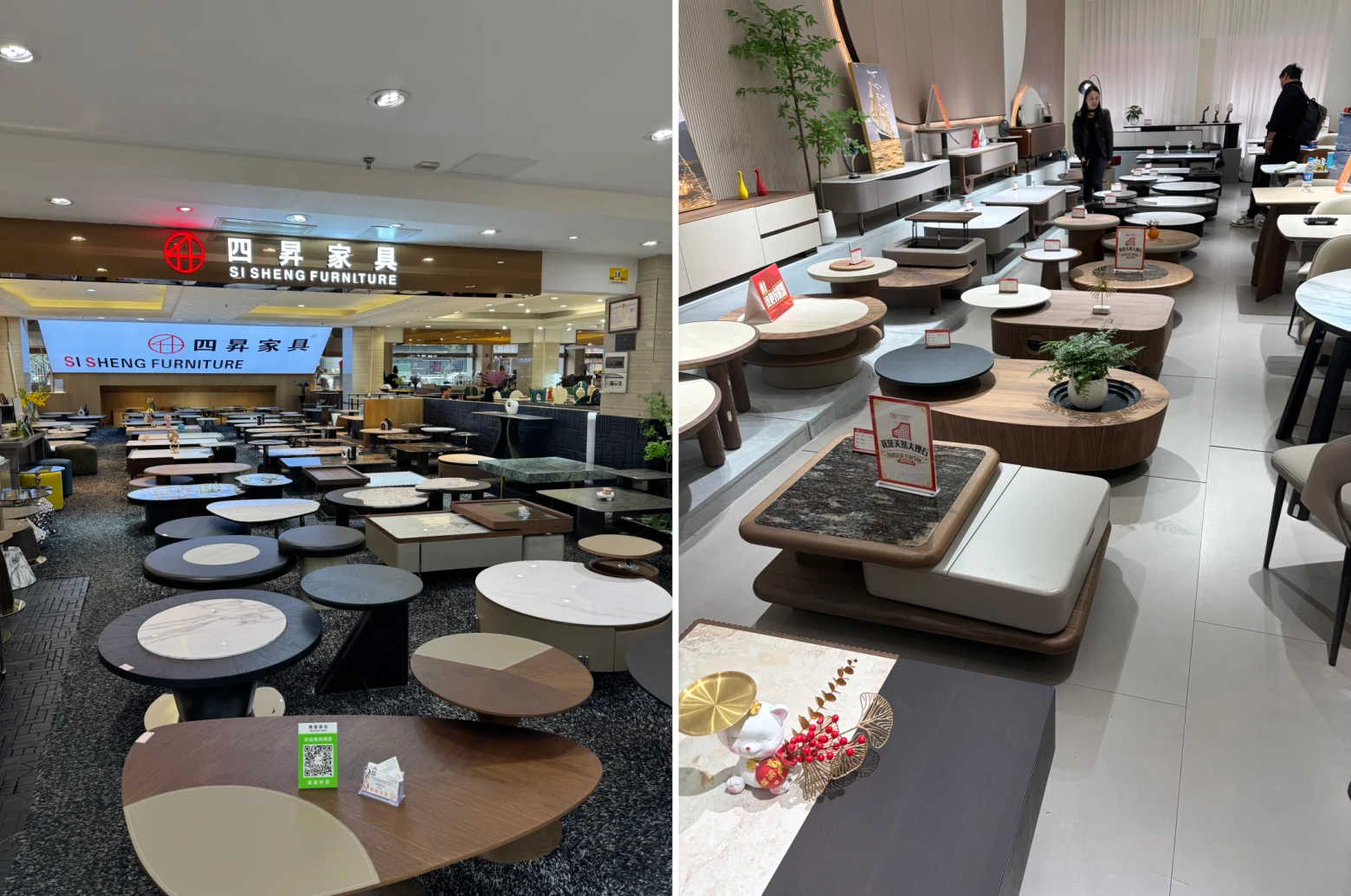
In this Lecong furniture market, round, square and irregular coffee tables stand next to one another. Some bases sit well inside the edge of the top, while others bring broad supports into view. A round table has a compact outline. A long table follows the line of a sofa, and an asymmetrical top can be wider at one end than the other. A display like this shows the range within one category. A furnished showroom puts those same shapes in the context of a room.
Nesting Tables and Sofa Side Tables
At Sunlink South, a small pale round top overlaps a lower woodgrain table. The two tops remain visually distinct and can be separated into individual tables. In Lecong sofa displays, freestanding side tables often sit close to the sofa arm. Some have a compact top on a single post. Others have a base that slides under the sofa. Nesting tables are designed around how the tops overlap. The shape of a side table often reflects the space next to the seat.

Freestanding and Floating TV Consoles
In showroom photographs from Lecong and Longjiang, a low freestanding console has doors at each end and an open compartment in the center. The horizontal grain emphasizes its length, and the floor supports are visible. In whole-room displays, the TV area can be integrated into wall panels and tall cabinets. Some designs suspend the lower unit, leaving the floor and any lighting below it visible. In Foshan showrooms, the same function appears both as a standalone piece and as part of a fitted wall.

4. Dining Tables, Chairs and Sideboards
Round, Rectangular, Oval and Extendable Tables
In a Longjiang showroom, curved-back chairs repeat the outline of a black round dining table. Lecong displays also include rectangular and oval tables. A rectangular table extends the dining area in one direction, and an oval keeps that length while rounding off the ends. Extendable tables build the change into the top itself, using a leaf or a sliding section to increase the length.

Four Legs, Center Pedestals and Twin Bases
One Foshan showroom pairs a pale round top with a dark center pedestal, leaving the edge of the table projecting on all sides. In another Lecong display, two separate supports hold up a long pale top. Four corner legs bring the supports closer to the tabletop’s edges, while twin bases leave an open span in the middle. Seen side by side, these examples show how much the base contributes to the overall shape of a dining table.

Wooden Chairs, Upholstered Chairs and Dining Benches
On this pale Lecong dining chair, the seat and back are upholstered separately. The seams curve around the sides of the back, and the wooden legs remain visible. Longjiang dining sets also include chairs that leave the curved wooden frame exposed. The first design draws attention to the upholstered surfaces. The second makes the lines of the back and frame more visible. A bench gives the long side of a dining table a continuous seat and changes the rhythm of the arrangement.

Low Sideboards, Glass Display Cabinets and Wine Storage
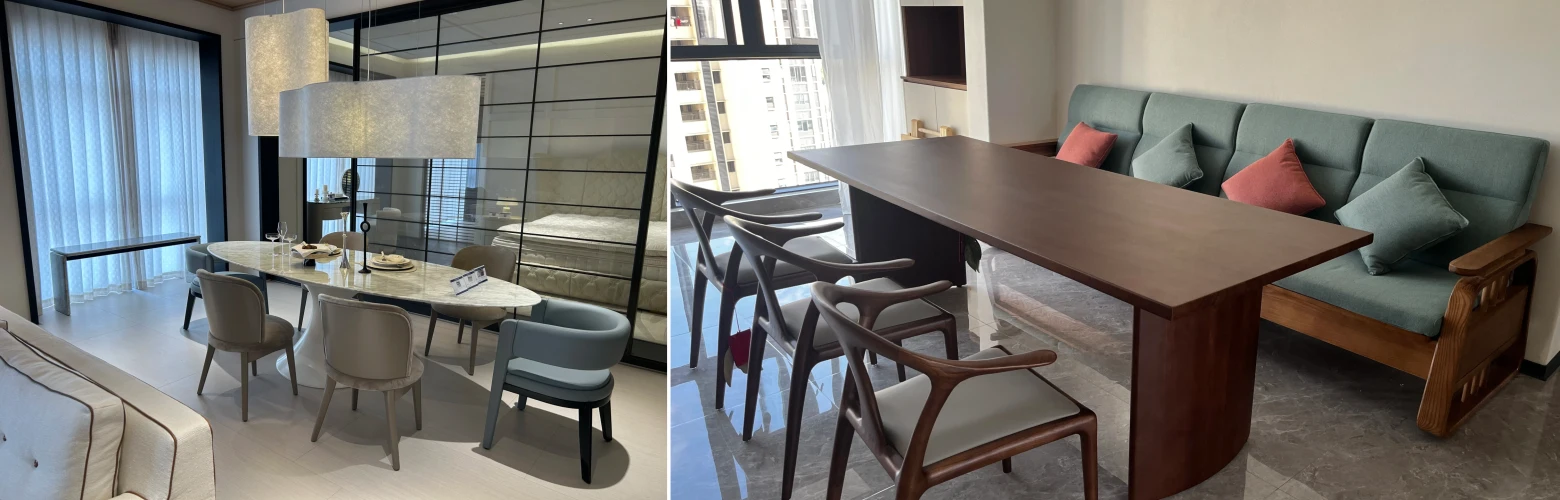
In a home photographed by a Foshan furniture professional, a wood-tone table and sideboard share the same room. The table and chairs define the dining area, while the sideboard follows the wall and provides a surface for small objects. A sideboard can be a freestanding piece with doors and drawers, as in Lecong furniture displays, or part of a fitted wall that also includes glass-front display cabinets or wine storage. Glazed doors keep objects visible, while solid fronts conceal the rest.

5. Bedroom Furniture: Beds, Nightstands and Dressers
Upholstered Headboards: Shape, Seams and Edges
On this pink bed in a Foshan showroom, the upholstered headboard is divided into small panels. Each seam casts a slight shadow across the matching fabric. The bed frame sits low, drawing the eye up to the headboard. As with the sofas made in Longjiang and Jiujiang, an upholstered bed brings together a frame, padding and a fabric cover. On a headboard, the panels meet across a broad vertical surface. Some beds continue the upholstery around the sides and foot to create a continuous surround.

Wooden Beds: Headboards, Legs and Frames
One bed photographed during visits to Lecong and Longjiang has a wide, uninterrupted headboard in dark wood. Pale bedding covers most of the mattress, while the exposed frame and legs carry the wood tone around the rest of the bed. Other displays on the same visit showed dressers and vanities nearby. In a Foshan bedroom showroom, a wooden bed can stand on its own or serve as the largest piece in a set, with smaller pieces picking up its color or lines.

Storage Beds with Drawers or Lift-Up Platforms
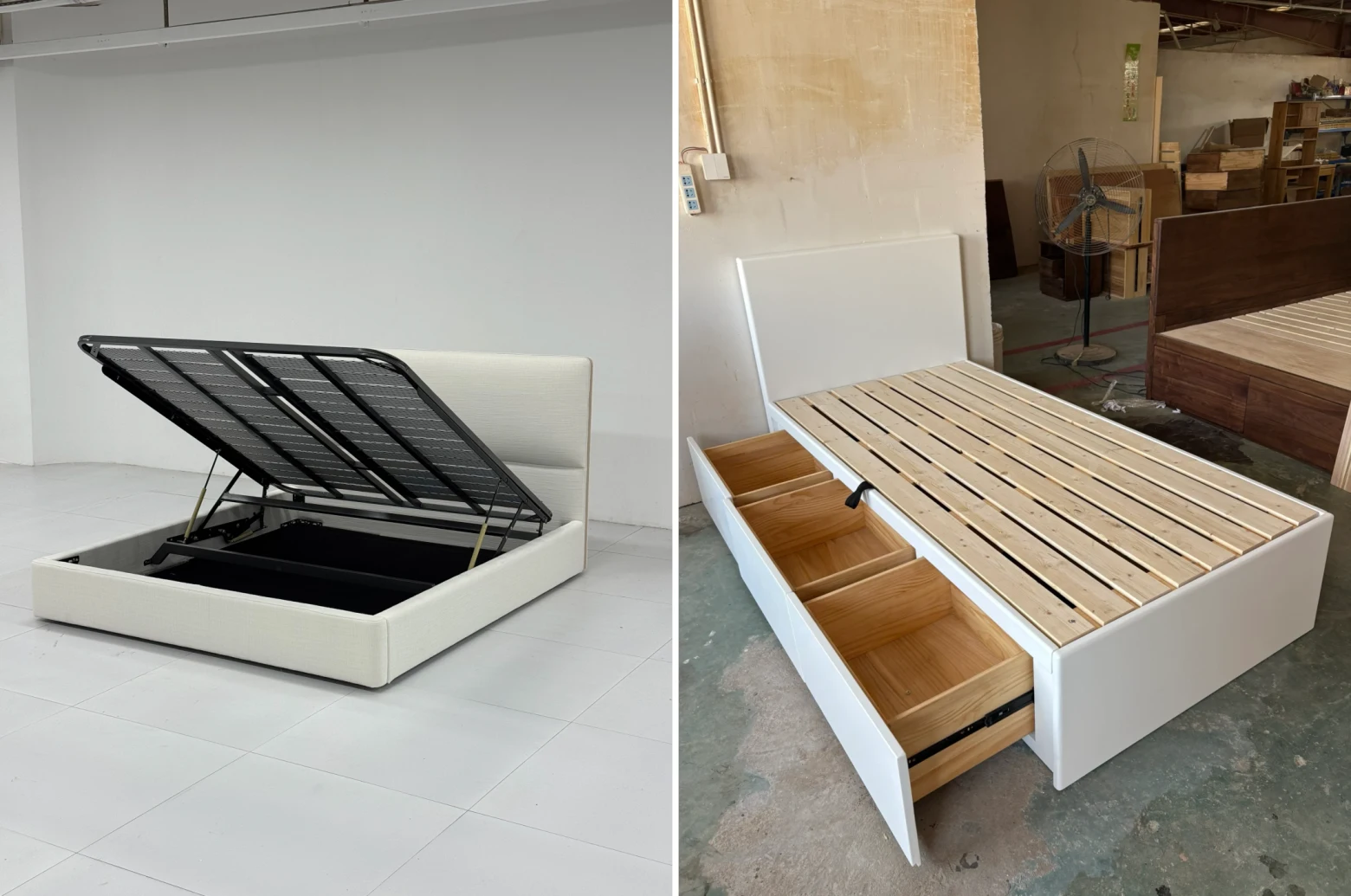
The storage bed illustrates how different parts of Shunde’s industry fit together. Manufacturers in Longjiang offer finished beds with lift-up storage, and hardware makers in Leliu produce gas struts for lifting the platform. A hinged platform lifts to reveal the storage compartment from above. A drawer bed divides the base into compartments that open from the sides. The photos show the support strut exposed under a raised bed platform and the drawer and wooden slats of a separate storage bed.
Nightstands, Dressers, Vanities and Bedroom Benches
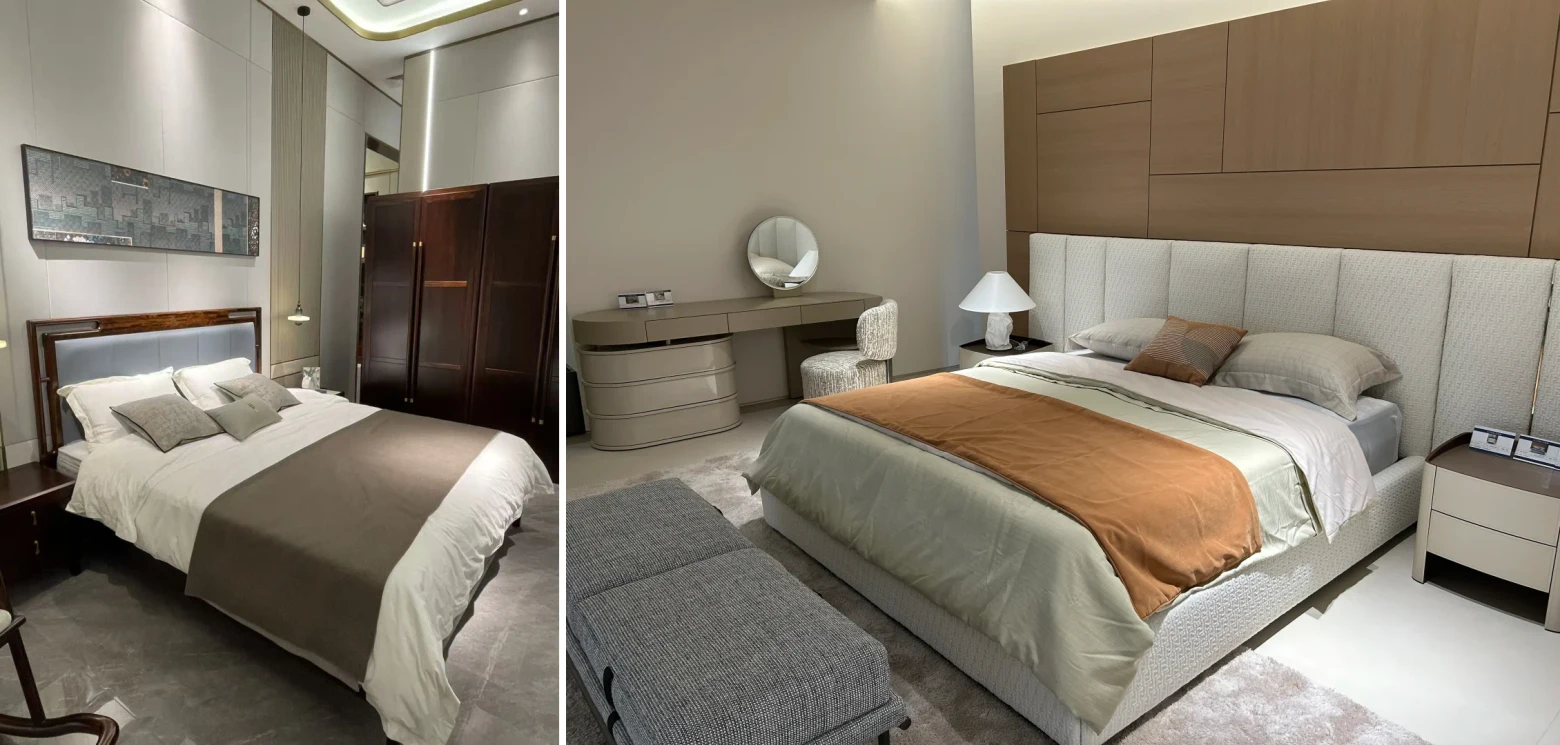
In one showroom arrangement from Lecong and Longjiang, a wood-tone dresser and vanity form a single piece. Drawers stack on one side, and the top extends over space for a stool and legroom. A matching bed and nightstand complete the display. A nightstand keeps a surface close to the mattress, a bench runs along the foot of the bed, and a dresser stacks storage higher. These different heights allow each piece to serve a different part of the same room.

6. Storage and Custom Cabinetry: Freestanding Pieces, Built-Ins and Kitchens
Freestanding Sideboards, Entry Cabinets and Bookcases
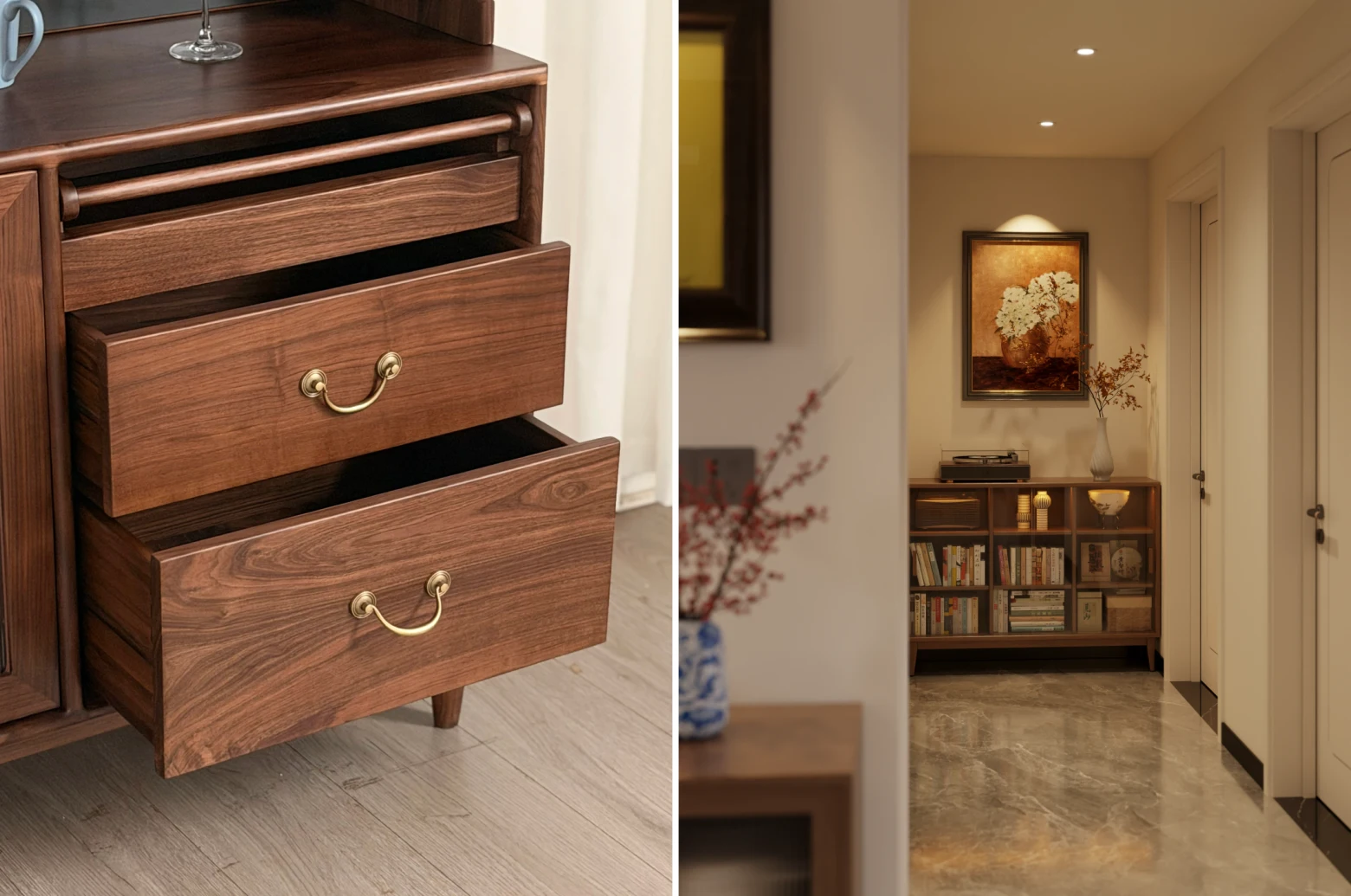
The three drawers of this Foshan sideboard open to compartments of different heights. With the drawers closed, the wooden fronts and metal pulls form the face of the piece. Freestanding storage has its own sides, back and base. Entry cabinets and bookcases can use the same construction, with shallow shelves, open compartments or glazed doors depending on what is stored or displayed. Hardware makers in Leliu supply parts for actions such as opening a hinged door or sliding a drawer. The photos do not identify the hardware brand on this piece.
Built-In Wardrobes, Walk-In Closets and Vanity Areas
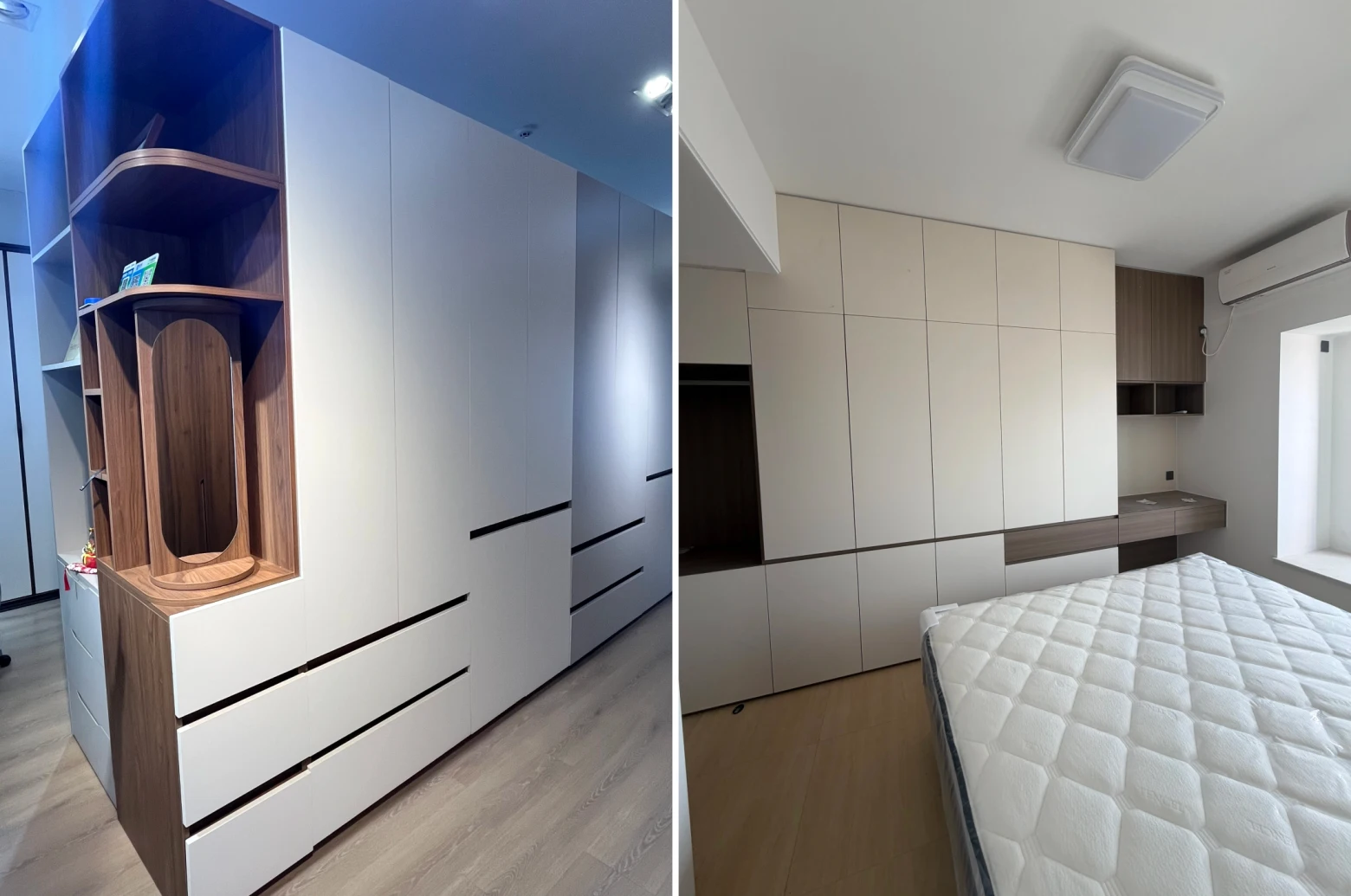
A full-height cabinet photographed during showroom visits to Lecong and Longjiang brings tall doors, lower drawers and an open niche into one continuous front. Inside, a similar layout can divide the storage into space for long garments, shelves and drawers. Foshan cabinetry suppliers also display doors, edge banding, hinges and drawer systems as separate components. A walk-in closet can leave the compartments open, while a vanity area can replace one section with a lower counter, a mirror and space to sit.
Kitchen Base Cabinets, Wall Cabinets, Tall Units and Islands
An island anchors this open kitchen in a Foshan showroom. Behind it, appliances fit into dark cabinetry, and wood finishes and countertop surfaces carry through the space. Base cabinets provide storage under the worktop. Wall cabinets use the upper wall, and tall units can enclose a refrigerator or oven. The island forms a separate bank of cabinets in the middle of the room. Shunde’s hinges, drawer systems and lift mechanisms are part of the supply network behind this type of cabinetry. The fronts and worktops are visible, while the hardware determines how each part opens.

Open Shelves, Media Space and Closed Storage in a Built-In Wall
In a home photographed by a Foshan furniture supplier, illuminated bookshelves, a long run of closed cabinets and a TV opening share one wall. The shelving is divided into small compartments, the TV has a wide opening, and the lower cabinet doors form a continuous line. A low console in a Lecong showroom can serve many of the same purposes. Here, the dimensions, storage compartments and lighting were worked into the wall as a whole.

7. Outdoor Furniture: Balconies, Terraces and Poolside Spaces
Small Tables, Lounge Chairs and Side Tables for Balconies
At one Foshan outdoor showroom, small tables and chairs are grouped along a timber platform. The round tables and individual chairs leave space between the seats and planters. It is an indoor display set up to show how furniture can fit on a small balcony. Farther along in the same showroom, larger sofas and longer tables are arranged to suit a different outdoor setting.

Modular Sofas and Outdoor Dining Sets for Terraces
Another part of the same Foshan showroom stages a terrace lounge, with a long pale sofa, individual chairs and a low table grouped around a central space. Shunde outdoor furniture makers also offer dining sets. On a larger terrace, the height of the furniture separates the two uses. Lounge seating sits low around a coffee table, while dining chairs and the table bring the group higher. Both photos show showroom arrangements for outdoor spaces.

Loungers, Umbrellas and Occasional Tables for Gardens and Pools
In another Lecong showroom, loungers stand in a row behind woven chairs. Their extended seats support the legs, in contrast to the upright seating in front. Local outdoor furniture manufacturers also offer dining tables, daybeds and other lounge furniture, which can serve different parts of a garden or pool area. An umbrella can stand on a center pole or project from a side arm. A low table keeps items within reach of a lounger.

Aluminum Frames, Wood, Rope Weave and Outdoor Cushions
In this Foshan showroom close-up, rope follows the curve of the frame, and separate cushions sit inside it. Shunde outdoor furniture maker Agio lists materials such as aluminum, teak and synthetic wicker across its ranges. The weave determines how open the back feels, the frame sets the outline, and the cushions form the surfaces that touch the body. The photographs show how those parts meet. The exact frame material depends on the product specifications.

8. Office Furniture: Seating, Shared Workstations and Meeting Spaces
Home Desks and Freestanding Office Desks
In Lecong’s Tuanyi office furniture market, a woodgrain desk sits at the center of a display with a chair behind it and storage to one side. The desk, side cabinet and chair show how a private office can be arranged with separate pieces. A home desk often uses a lighter top and frame and can be paired with a movable drawer unit. A dining table in a residential showroom may have a similarly large top, while an office desk more often has document storage arranged alongside it.

Mesh Office Chairs, Upholstered Office Chairs and Meeting Chairs
In the Tuanyi showroom, a mesh back is stretched inside a frame, with the arms, seat and base clearly visible as separate parts. Local industry reporting identifies office chair development and manufacturing as part of Jiujiang’s furniture sector in Nanhai. The Lecong display shows the finished chair, while Jiujiang illustrates the manufacturing side of the category. A padded back changes the profile of an office chair. Meeting chairs can use four legs or a cantilever base, which changes how a row of chairs looks around a table.

Frames, Screens and Cable Routing for Shared Workstations
In a Foshan office furniture showroom, a row of workstations has a low divider down the middle and seating on both sides. Product information from another Nanhai manufacturer shows how a workstation frame can also house cables and connections. Repeated desk frames make it possible to extend the row. Screens define individual work areas, and cable routes bring power and connections to the desks. The photos show the layout and dividers. The manufacturer describes the cable routing in its product information.

Meeting Tables, Reception Sofas and Waiting Area Seating
A long meeting table in a Foshan showroom places chairs in two rows facing each other. A separate Tuanyi display groups a low brown sofa and coffee table into a reception area. Foshan also manufactures public seating. For example, Nanhai-based Oshujian lists beam seating for airports and hospitals. Each arrangement fits a different use: around a table for meetings, facing a shared center for conversation, or side by side while waiting.

9. Furniture Styles in Foshan Showrooms
Modern Minimalism: Low Backs, Flat Doors and Slim Frames
In one Foshan showroom, low gray sofas curve around pale coffee tables at different heights. Another display from the same visit combines open shelving with closed cabinet doors. These are examples of how Foshan showrooms present modern minimalism through low backs, slim edges and few seams. Fabric texture and woodgrain provide much of the visual detail. The style can be expressed in upholstered seating, wood furniture or fitted cabinetry.

Wabi-Sabi: Muted Colors, Textured Fabrics and Soft Shapes
Some Foshan showrooms feature wabi-sabi arrangements. In the display shown here, pale fabrics, round wood-tone tables and daylight bring the colors close together, while rounded upholstery gives the seats their shape. In these settings, the style comes through in low seating, gentle curves, uneven weaves and the sheen of the wood. The overall look depends on the pieces as well as the light and finishes around them.

Understated French-Inspired Furniture: Curves, Slender Legs and Light Upholstery
Two pale upholstered chairs in a Longjiang showroom turn their curved backs toward a low table, against a wall with restrained detailing. Other Foshan showrooms describe a similar approach as understated French style. Here, curved backs and piping soften the outline, the pattern is concentrated on the chairs, and the tables have a smaller footprint. Fabrics, leg profiles and the amount of ornament vary from showroom to showroom.

Vintage-Inspired Furniture: Warm Wood, Exposed Frames and Rounded Edges
In home photographs shared by a Foshan furniture professional, a warm wood dining table, chairs and a sideboard sit together. The legs of the table and chairs remain visible, and divided cabinet fronts give the sideboard its rhythm. The same wood tone ties the pieces together. Visible frames, legs and rounded edges are also familiar in Longjiang woodworking. They are both structural and decorative, and can give newly made furniture a vintage character.

Contemporary Chinese Furniture: Wooden Arms, Latticework and Framed Doors
In a living room photographed by a Foshan furniture supplier, the armchairs, long seat and coffee table use dark frames. Light cushions make the frame lines stand out. Photographs from a Longjiang woodworking shop show an earlier stage, when the wooden parts are still being shaped or assembled. In the finished room, exposed arms, continuous frame lines and upholstery work together. The frame and arm profiles give the seating its Chinese character, while the cushions and color palette suit a contemporary room.

10. Materials and Craft: Wood, Upholstery, Metal and Table Surfaces
Solid Wood Parts, Wood Veneer and Panel Cabinetry
In photographs from Lecong and Longjiang, an opened piece of wooden furniture reveals panels, grain and support hardware. The finished surface and the structure underneath are visible together. Foshan cabinet suppliers display wood finishes, panel options and edge banding, while manufacturers in Leliu make parts such as connectors and hinges. Solid wood, veneer and engineered panels can each be used in different parts of the same piece. A photo can show the grain and construction. Identifying the material underneath the finish requires product information.

Fabric and Leather Upholstery: Cut Panels, Seams and Wrapping
On a striped sofa photographed at a Foshan showroom, the direction of the stripes changes where the fabric passes from the back to the arm. The seat cushion is finished along its own edge. Alongside the Lecong fabric book, this photograph shows what happens when a flat swatch becomes a three-dimensional cover. Fabric or leather panels are cut for the arms, seat and back, then joined to follow the curves. The finish depends on where the seams fall, how patterns meet and which cushions remain separate.
Metal Table Frames, Chair Legs and Connections
In one Foshan showroom, slim legs lift a narrow black cabinet off the floor, leaving the area underneath open. In Foshan office furniture, metal also appears in longer table frames, crossbars and dividers. It serves a similar supporting role, whether it forms slender legs or an entire load-bearing frame. Mounting plates and fasteners often sit beneath the top. The photos show how the supports meet the floor, while the alloy and finish cannot be established from color alone.

Edges and Bases for Stone, Sintered Stone and Glass Tops
A pale patterned dining table in Lecong has rounded corners and dark supports visible below the top. Foshan’s Nanzhuang area also has suppliers of countertop materials. Delfone, for example, lists sintered stone surfaces in its range. The showroom and the slab supplier show different sides of the finished table. Tops can be made from natural stone, sintered stone or glass, and details such as a beveled edge or a darker base change how thick and heavy the table looks.

11. From Individual Pieces to Whole Rooms
Sofas, Tables and Built-In Storage in the Living Room
A complete Foshan living room display places a wood-framed sofa, low tables and a wall of storage in one view. Similar wood tones tie the sofa frame to the cabinetry, and the light cushions stand out against the darker wall. In Lecong markets, rows of coffee tables reveal how much variation there is within the category. A full living room shows a different relationship: the height of the sofa back, the line of the table and the vertical divisions of the cabinetry are seen together.

Tables, Chairs and Sideboards in an Open Living and Dining Room
In a Foshan showroom, a pendant hangs over a table and a row of chairs, with the edge of a sofa visible in the foreground. In a separate home photographed by a Foshan furniture professional, a wood-tone sideboard runs alongside the dining table. The pendant and dining set define one area. A cabinet along the wall adds a parallel line, while the lower height and softer profile of the living room seating mark the transition to the next area.
Beds, Nightstands and Wardrobes in a Bedroom
In a Foshan bedroom display, the headboard, low nightstand and tall cabinet establish three different heights. Dark woodgrain appears on the frames and cabinets, with pale bedding between the pieces. Other showroom photographs from the same series show wooden beds and freestanding dressers. The bed and nightstand can read as a set, while a full-height cabinet extends along the edge of the room. Staging them together shows how freestanding furniture and fitted cabinetry share the available space.
Wood Tones, Textiles and Metal Details Across Rooms
In photographs of the same home shared by a Foshan furniture professional, a small table by the window and a bedroom dresser both use warm wood tones. They differ in scale and function. The window-side table and chair have slim, visible supports. The dresser has a heavier, continuous front. The repeated wood tone connects the rooms, while the textiles and lighting vary from one area to another.

Photos from Six Lecong Furniture Venues
Louvre International Furnishings Expo Center

Sunlink Furniture City North

Sunlink Furniture City South

Empire International Furniture City

Red Star Macalline Foshan Lecong Mall

Tuanyi International Office Furniture City
